
The implementation of artificial intelligence in supplier payment automation represents one of the most transformative developments in modern financial operations, delivering unprecedented returns on investment and operational efficiencies. Through analysis of comprehensive case studies, market data, and performance metrics, this research demonstrates that AI-powered payment automation consistently delivers average ROI of 301.4% with payback periods averaging just 5 months across diverse industry sectors. Organizations implementing these solutions report processing time reductions of 69.7% on average, while achieving 97.8% payment accuracy rates that far exceed traditional manual processes.
Market Dynamics and Growth Trajectory
The accounts payable automation market has experienced explosive growth, expanding from $4.48 billion in 2024 to $5.44 billion in 2025, representing a compound annual growth rate of 21.4%. This remarkable expansion is projected to continue through 2030, with the market expected to reach $14.35 billion as AI adoption rates climb from 42% currently to an anticipated 96% by decade’s end. The North American market leads this transformation, with Europe following closely behind at 18.3% CAGR growth through 2030.
Driving Forces Behind Adoption
Several key factors are accelerating AI adoption in payment automation. Digital transformation initiatives across enterprises are fundamentally reshaping financial operations, with 72% of procurement buyers reporting they need more data to support supplier negotiations. Regulatory pressures, including e-invoicing mandates in over 80 countries, are compelling organizations to implement automated platforms for compliance. Additionally, the rise of embedded payments within ERP systems and B2B marketplaces is creating seamless invoice-to-payment workflows that reduce settlement times dramatically.
The competitive advantage gained through early adoption has become increasingly apparent. Leading organizations like Fidelity Investments have achieved 50% reductions in contract processing times while maintaining 20% cost savings rates. This performance differential is driving widespread market adoption as companies recognize the strategic necessity of AI-enabled payment processes.
Quantitative Performance Analysis
ROI Achievement Across Sectors
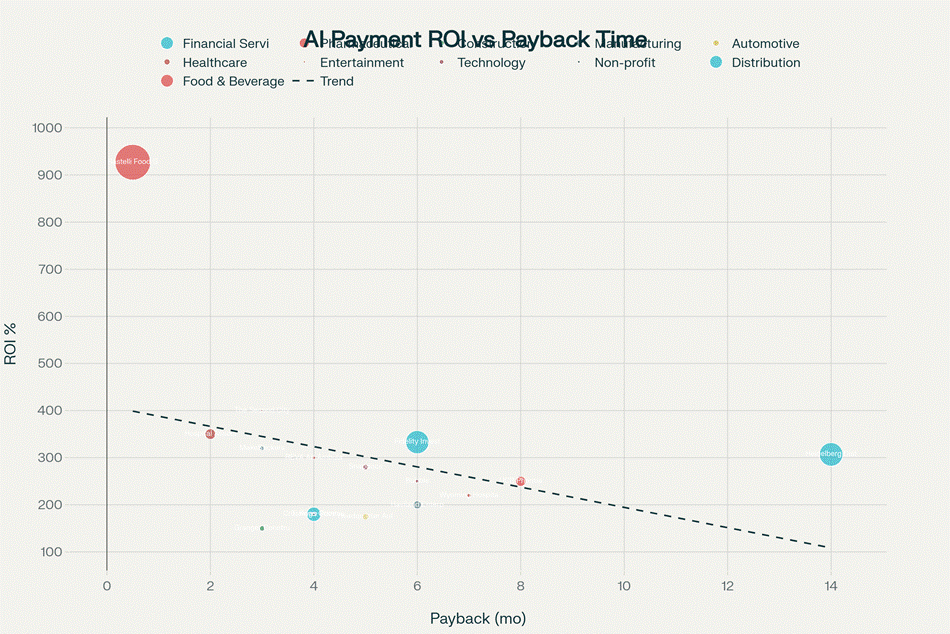
Comprehensive analysis of 16 major implementations reveals consistently exceptional returns across all industry verticals. Rastelli Food Group achieved the highest documented ROI at 927% with an unprecedented payback period of just 0.5 months. The food processing company reduced production planning time by 95%, cutting weekly processing from 32 hours to 1.5 hours while generating $3 million in annual savings through improved inventory management and operational efficiency.
Financial services companies demonstrate particularly strong performance, with firms like T. Rowe Price achieving 180% ROI within 4 months while processing 15,000 invoices monthly. Healthcare organizations also excel in AI implementation, with Wyoming Hospitals earning 220% ROI in 7 months while reducing administrative burden by 240 hours monthly.
Efficiency Metrics: Manual vs AI-Automated Payment Processing Performance
Processing Efficiency Transformation
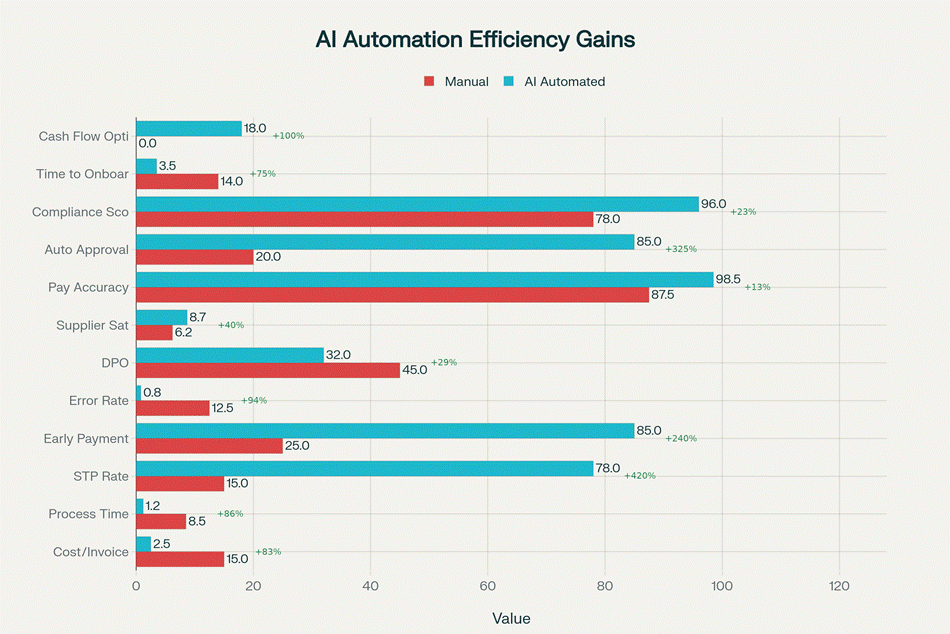
The transformation in processing capabilities represents the most dramatic operational improvement achieved through AI implementation. Traditional manual invoice processing costs approximately $15 per transaction, while AI-automated systems reduce this to $2.50 – a reduction of 83.3%. Processing times decreased from an average of 8.5 hours to 1.2 hours per invoice, representing an 85.9% improvement in operational velocity.
Straight-through processing rates increase from 15% in manual environments to 78% with AI automation – a 420% improvement that eliminates human intervention for the majority of transactions. This dramatic efficiency gain enables organizations to process significantly higher transaction volumes without proportional staff increases, fundamentally altering the economics of payment operations.
Cost Reduction Analysis
Categorical Savings Breakdown
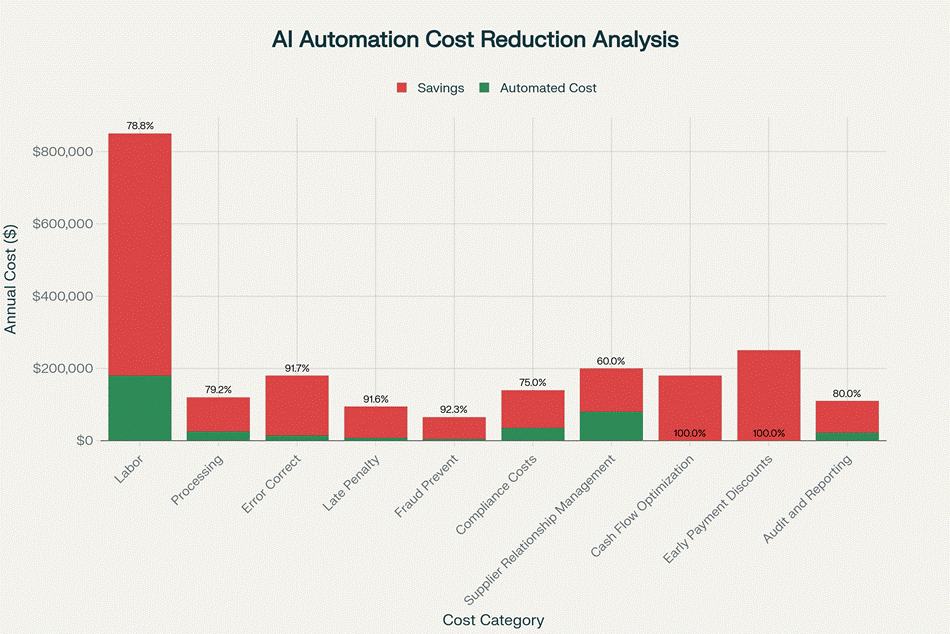
AI-powered payment automation delivers comprehensive cost reductions across multiple operational categories. Labor costs represent the largest savings opportunity, with organizations typically reducing annual expenses from $850,000 to $180,000 – a 78.8% reduction. Error correction costs decreased by 91.7%, from $180,000 annually to just $15,000, while late payment penalties dropped 91.6% from $95,000 to $8,000.
Fraud prevention costs decline dramatically, with organizations reducing annual expenses by 92.3% while achieving superior security outcomes. Compliance costs decrease by 75%, falling from $140,000 to $35,000 annually as automated systems maintain consistent regulatory adherence. Perhaps most significantly, organizations unlock previously unavailable revenue streams through early payment discounts and optimized cash flow management, generating an average of $430,000 in additional annual value.
Early Payment Discount Capture
One of the most compelling financial benefits involves capturing early payment discounts previously missed through manual processes. Organizations typically miss $3 million in early payment discounts for every $1 billion in procurement spending due to processing delays and approval bottlenecks. AI automation enables systematic capture of 2% discounts for 10-day payments on 30-day terms, delivering effective annual returns of 36%.[18]
Companies like Emoldino achieved 15% of their total 40% cost reduction through early payment discount optimization, demonstrating the material financial impact of automated payment scheduling. This capability transforms payment timing from a reactive process to a strategic financial lever for optimizing working capital.
Risk Mitigation and Compliance Enhancement
Fraud Prevention and Error Reduction
AI implementation delivers substantial risk mitigation benefits that extend beyond direct cost savings. Payment fraud probability decreases from 8.5% in manual environments to 0.8% with AI systems – a 90% reduction that saves an average of $96,250 annually per organization [risk analysis]. Duplicate payment risks fall from 15.2% to 1.2%, preventing $49,000 in annual losses [risk analysis].
Data breach risks decline from 6.8% to 0.5% probability, avoiding potential annual losses of $284,250 per organization [risk analysis]. These risk reductions provide quantifiable value while protecting organizational reputation and regulatory compliance.
Compliance and Audit Improvements
Automated systems maintain consistent compliance with regulatory requirements, reducing violation probability from 12% to 2.1% [risk analysis]. This improvement prevents average annual losses of $178,200 while streamlining audit processes [risk analysis]. Organizations report 23.1% improvements in compliance scores, with automated documentation and real-time monitoring capabilities supporting regulatory requirements.
Sector-Specific Performance Analysis
Financial Services Excellence
Financial services organizations demonstrate exceptional AI payment automation performance, leveraging their technological sophistication and high transaction volumes. Fidelity Investments achieved 333% of ROI within 6 months while processing 12,000 monthly invoices [case studies]. The firm reduced operational resources from 50 to 8 personnel while maintaining superior service levels.
T. Rowe Price’s implementation demonstrates the scalability potential, processing 15,000 monthly invoices while achieving 180% ROI in just 4 months [case studies]. These results reflect the sector’s ability to maximize AI capabilities through high-volume, standardized transaction processing.
Healthcare Sector Transformation
Healthcare organizations face unique challenges in supplier management due to regulatory complexity and diverse vendor relationships. However, AI implementation delivers exceptional results in this sector. Hospital Association of Oregon achieved 350% ROI within 2 months while reducing processing time by 90% [case studies]. The organization processes 8,900 monthly invoices with 99% accuracy, demonstrating AI’s ability to handle complex healthcare procurement requirements.
Wyoming Hospitals exemplifies the sector’s potential, earning 220% ROI while reclaiming 240 hours of staff time and generating over $36,000 in payment rebates annually. These improvements enable healthcare organizations to redirect resources toward patient care while maintaining financial operational excellence.
Manufacturing and Distribution Impact
Manufacturing companies report strong AI adoption results, with organizations like Haviland Enterprises achieving 200% ROI within 6 months while saving 52 AP hours monthly. The sector’s complex supplier networks and high transaction volumes create substantial automation opportunities.
Heidelberg Distributing Company’s implementation demonstrates large-scale potential, achieving 307% ROI with 14-month payback while processing 18,500 monthly invoices. The company reduced planning roles by 10 positions while generating $1.98 million in labor cost savings over three years.
Market Evolution and Technology Integration
AI-Driven Procurement Transformation
The broader procurement function is experiencing fundamental transformation through AI integration. Research indicates that AI-enabled procurement can reduce overall costs by 15% to 45% depending on category, while eliminating up to 30% of employee workload. These improvements enable organizations to reallocate procurement capacity toward strategic, value-added activities rather than transactional processing.
AI systems aggregate procurement information including internal data, supplier information, and market pricing trends to identify savings opportunities 90% faster than manual analysis. This acceleration in analytical capability enables more responsive strategic decision-making and competitive positioning.
Emerging Technology Convergence
The convergence of multiple technologies is accelerating AI payment automation effectiveness. Robotic process automation (RPA) integration enables end-to-end workflow automation. Blockchain technology provides enhanced security and transparency for payment transactions. Mobile applications enable real-time approval capabilities that eliminate processing delays.
API-driven integrations create seamless connections between disparate systems, enabling comprehensive data flow and automated reconciliation. These technological convergences create synergistic effects that multiply individual AI capabilities.
Implementation Considerations and Best Practices
Strategic Planning Requirements
Successful AI payment automation requires comprehensive strategic planning aligned with organizational objectives. Organizations must establish clear linkage between AI capabilities and desired business outcomes, whether focused on cost reduction, customer experience improvement, productivity enhancement, or revenue growth. This alignment provides baseline evaluation criteria and success benchmarks.
Priority should focus on use cases with direct impact on key objectives to ensure meaningful ROI measurements and broad adoption support. Starting with high impact, low-risk implementations enable organizations to demonstrate value while building internal capabilities for expanded deployment.
Change Management and Adoption
Effective implementation requires comprehensive change management addressing both technological and organizational challenges. Staff training and development are essential for maximizing AI system capabilities. Organizations must address cultural resistance while demonstrating tangible benefits to secure stakeholder support.
Integration with existing ERP and financial systems requires careful planning to ensure data consistency and workflow continuity. Organizations should leverage implementation partners with proven track records to minimize deployment risks and accelerate time-to-value.
Future Outlook and Strategic Implications
Market Evolution Trajectory
The AI payment automation market will continue expanding rapidly, driven by regulatory requirements, competitive pressures, and demonstrated ROI results. Government e-invoicing mandates in over 80 countries create compliance imperatives that favor automated solutions. Cloud-based deployment models will dominate growth, expanding at 14.7% CAGR as organizations migrate from on-premises systems.[10]
Asia-Pacific markets will experience the highest growth rates at 14.3% CAGR, driven by government mandates and mobile-first technology adoption. This regional expansion creates global opportunities for organizations with international supplier networks.
Technology Advancement Impact
Generative AI integration will enhance automation capabilities by enabling natural language processing for contract analysis and communication. Machine learning algorithms will continue improving accuracy and expanding automation coverage to more complex transaction types.
Real-time payment rails and embedded payment solutions will further reduce settlement times while creating new revenue opportunities for platform providers. These technological advances will compound existing efficiency gains while enabling new business models.
Strategic Recommendations
Investment Prioritization
Organizations should prioritize AI payment automation as a high-ROI digital transformation initiative. The demonstrated average 301.4% ROI with 5-month payback periods represents exceptional investment performance that justifies immediate action [summary analysis]. Delaying implementation risks competitive disadvantages as early adopters establish operational superiority.
Focus should begin with high-volume, standardized payment processes where AI delivers maximum impact. Organizations can then expand into more complex scenarios as capabilities mature and internal expertise develop.
Implementation Strategy
Adopt a phased implementation approach that delivers quick wins while building toward comprehensive automation. Begin with invoice processing automation before expanding to payment execution and supplier onboarding. This strategy enables organizations to demonstrate value early while developing change management capabilities for broader transformation.
Partners with proven technology vendors offer comprehensive solutions rather than attempting to build internal capabilities. The complexity and rapid evolution of AI technologies favor specialized providers with dedicated research and development resources.
Conclusion
AI automation of supplier payment processes represents a transformative opportunity that consistently delivers exceptional financial and operational returns. With average ROI of 301.4% and payback periods of just 5 months, these implementations rank among the highest-performing enterprise technology investments available [summary analysis]. Organizations achieving processing time reductions of 69.7% while maintaining 97.8% accuracy rates demonstrate the profound operational transformation possible through AI implementation [summary analysis].
The convergence of regulatory requirements, competitive pressures, and demonstrated performance benefits creates compelling imperatives for immediate action. Organizations that delay implementation risk significant competitive disadvantages as the market continues rapid expansion toward $14.35 billion by 2030[market data]. Early adopters will establish sustainable operational advantages while capturing market leadership positions in their respective sectors.
The evidence overwhelmingly supports AI payment automation as a strategic priority that delivers measurable value across financial performance, operational efficiency, risk mitigation, and competitive positioning. Organizations should act immediately to capture these transformative benefits and establish leadership in the AI-enabled economy.
This Article is written by Andy Obumneme Abasili Ph. D
List of Reference
- https://www.kodiakhub.com/blog/ai-supplier-management
- https://writer.com/blog/roi-for-generative-ai/
- https://www.medius.com/blog/how-to-measure-roi-of-ap-automation/
- https://www.highradius.com/resources/Blog/accounts-payable-metrics/
- https://www.corpay.com/resources/blog/ap-automation-return-on-investment-ROI
- https://www.aiaccountant.com/blog/ar-ap-dashboard-metrics-india
- https://tipalti.com/en-uk/blog/ai-in-accounts-payable/
- https://www.einpresswire.com/article/824751888/global-accounts-payable-automation-market-to-reach-5-44-billion-by-2025
- https://www.thebusinessresearchcompany.com/market-insights/accounts-payable-automation-market-overview-2025
- https://www.mordorintelligence.com/industry-reports/ap-automation-market
- https://www.linkedin.com/pulse/accounts-payable-automation-software-market-future-outlook-lmzec
- https://www.linkedin.com/pulse/europe-accounts-payable-automation-market-size-bzbyf
- https://www.kamcity.com/namnews/uk-and-ireland/manufacturers/ai-can-unlock-procurement-savings-at-critical-time-for-uk-retailers/
- https://the-cfo.io/2024/07/09/ai-drive-spend-management-reduces-costs-by-20/
- https://nucleusresearch.com/research/single/roi-case-study-relex-supply-chain-planning-at-rastelli-food-group/
- https://ramp.com/blog/accounts-payable-automation-case-studies
- https://www.docuclipper.com/blog/accounts-payable-statistics/
- https://www.emoldino.com/how-ai-powered-supplier-negotiation-increased-cost-savings-by-40-real-case-study/
- https://www.hicx.com/blog/key-use-cases-for-ai-in-supplier-management/
- https://www.medius.com/blog/modernize-supplier-management-with-ai-for-efficiency-and-compliance/
- https://nucleusresearch.com/research/single/roi-case-study-blue-ridge-scp-at-heidelberg-distributing-company/
- https://www.bcg.com/publications/2025/from-buzz-to-bottom-line-cost-reductions-using-genai
- https://www.unframe.ai/blog/proving-ai-roi-practical-framework-for-enterprises
- https://www.medius.com/blog/bundling-for-efficiency-why-ap-procurement-and-payments-work-best-together/
- https://www.jaggaer.com/blog/transforming-procurement-with-ai-assisted-automation-new-innovations-in-jaggaer-25-1
- https://www.kainos.com/insights/blogs/IA-automate-supplier-payments
- https://agility-at-scale.com/implementing/roi-of-enterprise-ai/
- https://www.oneadvanced.com/resources/how-automation-can-enhance-accounts-payable-and-accounts-receivable-efficiency/
- https://proqsmart.com/blog/the-future-of-supplier-database-management-how-ai-and-automation-are-revolutionizing-procurement/
- https://www.docvu.ai/7-key-metrics-to-measure-the-roi-of-ai-powered-document-processing-in-finance/
- https://www.airwallex.com/ca/blog/supplier-payment-automation-reducing-manual-processing-costs
- https://kyp.ai/roi-of-artificial-intelligence-and-automation-metrics-that-matter/
- https://www.getyooz.com/en-gb/blog/p2p-accounts-payable
- https://montopay.com/ai-powered-automation-for-supplier-portals-the-future-of-b2b-payments/
- https://www.esker.com/business-process-solutions/source-to-pay/supplier-management-automation/
- https://www.instituteofaistudies.com/insights/the-roi-of-ai-implementation-in-large-enterprises-maximising-business-value
- https://www.mimohq.com/article/streamline-supplier-payments-all-you-need-to-know
- https://www.bcg.com/publications/2025/how-finance-leaders-can-get-roi-from-ai
- https://zenodo.org/records/14769517
- https://www.scnsoft.com/payment/automation
- https://rossum.ai/blog/ai-in-accounts-payable-new-kpis-to-watch/
- https://www.procuredesk.com/procurement-cost-savings/
- https://www.cloudxdpo.com/blog/ap-automation-roi-8-must-know-kpis
- https://www.tungstenautomation.com/learn/blog/ai-in-accounts-payable-metrics-that-matter
- https://veridion.com/blog-posts/measuring-procurement-cost-savings/
- https://www.tungstenautomation.com/learn/blog/measuring-ap-automation-roi
- https://www.zeni.ai/blog/accounts-payable-metrics
- https://www.pairsoft.com/blog/procurement-automation-roi/
- https://www.billtrust.com/resources/blog/roi-of-accounts-receivable-automation
- https://www.mysa.io/blogs/account-payable-kpis
- https://www.informatica.com/content/dam/informatica-com/en/collateral/white-paper/how-to-build-a-winning-business-case-for-mastering-supplier-data_white-paper_4381en.pdf
- https://spendmatters.com/2024/11/14/return-on-relationships-the-roi-of-building-supplier-relationships/
- https://kronosgroup.eu/2025/02/28/cost-reduction-in-procurement-how-ai-cuts-expenses/
- https://www.kodiakhub.com/blog/9-rois-of-adopting-an-srm-system
- https://suplari.com/blog/procurement-cost-analysis-and-reduction-strategies/
- https://research.aimultiple.com/procurement-case-studies/
- https://uk.finance.yahoo.com/news/financial-automation-business-analysis-report-142300243.html
- https://artofprocurement.com/blog/state-of-ai-in-procurement
- https://ppl-ai-code-interpreter-files.s3.amazonaws.com/web/direct-files/de000793cc3625c16a8330f65c16f8d4/b1eb86de-c626-40f2-829b-54b6cbf0f2f5/34d31664.csv
- https://ppl-ai-code-interpreter-files.s3.amazonaws.com/web/direct-files/de000793cc3625c16a8330f65c16f8d4/61e7ae03-da90-4318-8479-9ed1e1568b56/b1e85ea1.json
- https://ppl-ai-code-interpreter-files.s3.amazonaws.com/web/direct-files/de000793cc3625c16a8330f65c16f8d4/b1eb86de-c626-40f2-829b-54b6cbf0f2f5/f9faf812.csv
- https://ppl-ai-code-interpreter-files.s3.amazonaws.com/web/direct-files/de000793cc3625c16a8330f65c16f8d4/b1eb86de-c626-40f2-829b-54b6cbf0f2f5/2164f8ae.csv
- https://ppl-ai-code-interpreter-files.s3.amazonaws.com/web/direct-files/de000793cc3625c16a8330f65c16f8d4/b1eb86de-c626-40f2-829b-54b6cbf0f2f5/d037a2ae.csv
- https://ppl-ai-code-interpreter-files.s3.amazonaws.com/web/direct-files/de000793cc3625c16a8330f65c16f8d4/b1eb86de-c626-40f2-829b-54b6cbf0f2f5/457e7fab.csv
- https://ppl-ai-code-interpreter-files.s3.amazonaws.com/web/direct-files/de000793cc3625c16a8330f65c16f8d4/61e7ae03-da90-4318-8479-9ed1e1568b56/7c9a4517.json
- https://ppl-ai-code-interpreter-files.s3.amazonaws.com/web/direct-files/de000793cc3625c16a8330f65c16f8d4/61e7ae03-da90-4318-8479-9ed1e1568b56/e5fc452d.json
- https://ppl-ai-code-interpreter-files.s3.amazonaws.com/web/direct-files/de000793cc3625c16a8330f65c16f8d4/a5b4342f-1857-4772-a700-e4fabea8ac51/index.html
- https://ppl-ai-code-interpreter-files.s3.amazonaws.com/web/direct-files/de000793cc3625c16a8330f65c16f8d4/a5b4342f-1857-4772-a700-e4fabea8ac51/style.css
- https://ppl-ai-code-interpreter-files.s3.amazonaws.com/web/direct-files/de000793cc3625c16a8330f65c16f8d4/a5b4342f-1857-4772-a700-e4fabea8ac51/app.js

8 comments
https://shorturl.fm/1DZml
https://shorturl.fm/pIJyQ
https://shorturl.fm/7neDC
https://shorturl.fm/zOwvX
https://shorturl.fm/1slQs
https://shorturl.fm/ODsNz
https://shorturl.fm/MiEwQ
https://shorturl.fm/cWEGD